
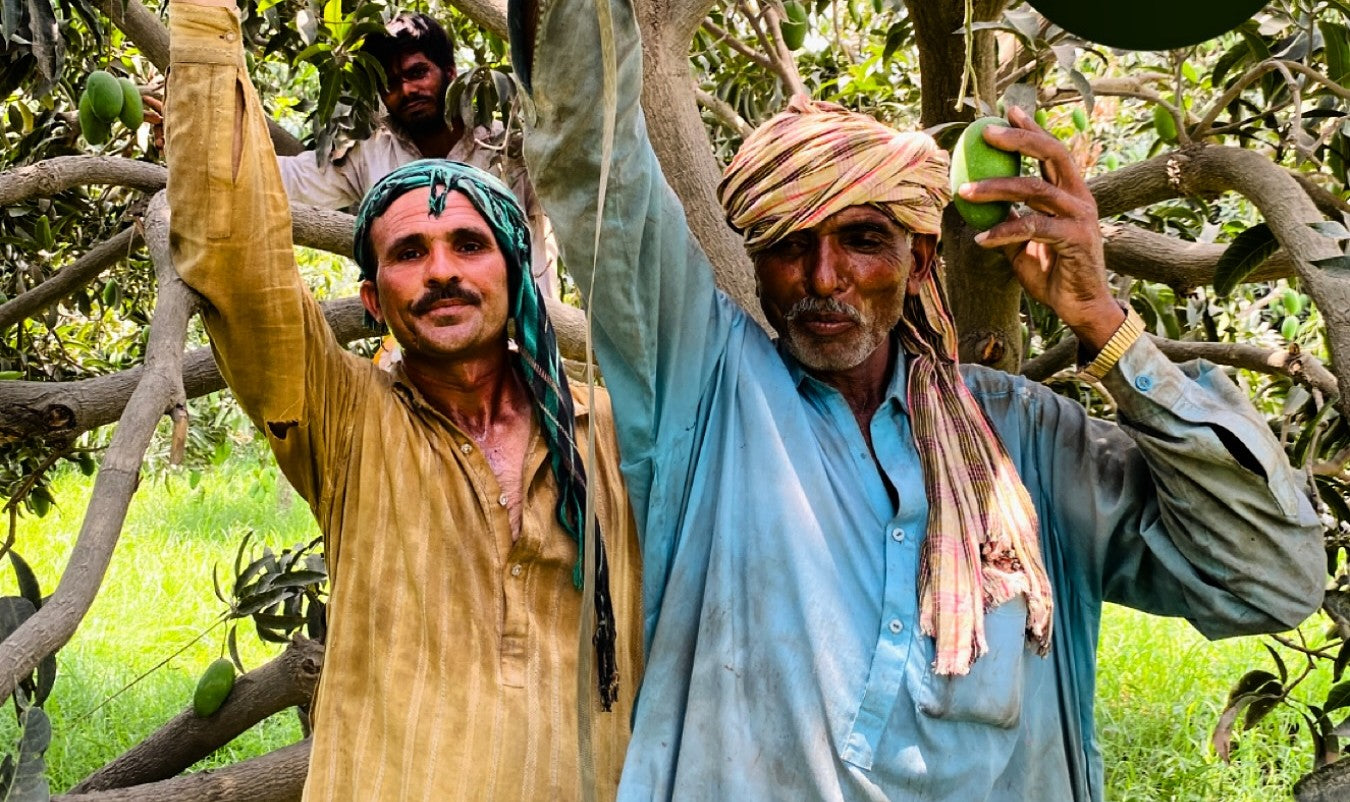
Chaunsa Mango: Pakistan's King — Complete Buyer's Guide 2026
Updated for the 2026 mango season by the Malik family — Multan, Pakistan.
If you've only ever eaten supermarket mangoes, you haven't really eaten Chaunsa. The fruit you find vacuum-shipped to grocery stores in the off-season is not the same fruit a Multani family pulls off a tree in late July. This guide explains, from a grower's perspective, what makes Chaunsa Pakistan's most prized mango — and how to spot a good one before you part with your money.
What is a Chaunsa mango?
Chaunsa (sometimes spelled "Chaunsa" or "Chausa") is a mid-to-late-season mango cultivar grown predominantly in Punjab, Pakistan. It is widely considered the country's premier dessert mango — prized for its high sugar content (typically 18–22° Brix at peak ripeness), thin skin, fiberless flesh, intense aroma, and complex flavor profile that includes notes of honey, citrus zest, and tropical floral.
The variety traces back to the courts of Sher Shah Suri in the 16th century. Modern Pakistani Chaunsa is essentially a refined heritage cultivar — the "old varieties" that survived because nothing else tasted quite as good. The fact that you can still eat a Chaunsa today that descends from trees the same family has tended for generations is part of what makes the experience feel different from a generic mango.
The three Chaunsas (and why this matters when you order)
"Chaunsa" is not one mango. It is a cultivar family with three commercially important sub-varieties — and the season window for each is different. Knowing which one you're getting tells you what to expect.
| Sub-variety | Window | What it tastes like |
|---|---|---|
| White Chaunsa (Sufaid Chaunsa) | Mid-July Mid-August | Pale-yellow skin, ultra-sweet, the most aromatic of the three. Considered the queen. |
| Honey Chaunsa | Late July Late August | Darker yellow-orange skin, bigger fruit, honey-forward flavor. Tougher skin = ships better. |
| Nawabpuri Chaunsa | July Late August | The premium grown variant. Smooth, fragrant, intensely sweet. Cultivated mostly in select Multan and Rahim Yar Khan orchards. |
At MMangoes, our flagship boxes are Nawabpuri White Chaunsa and Mosami White Chaunsa — both white varieties at the peak of the curve. They are not the cheapest mangoes in Pakistan, and they shouldn't be: the trees they come from produce a fraction of the yield of commercial cultivars, but every fruit is in a different league.
How to spot a real Chaunsa: 6 grower's tests
Before we get into how to order online, here is how we judge Chaunsa at the farm — useful if you're buying from a local fruit vendor.
1. Smell, before everything else
A real ripe Chaunsa will perfume the room. Hold the fruit close to your nose and inhale deeply — you should smell honey, jasmine, and a hint of resin. No smell? Either it's not ripe yet (give it 2–3 days at room temperature) or it was picked too early.
2. Squeeze, gently
Press near the stem with your thumb. A ripe Chaunsa gives slightly — like a perfectly ripe peach. If it's rock hard, it'll ripen on the counter. If it's mushy, it's overripe; the fruit beneath the skin will be fermented.
3. Look at the shoulder
The "shoulder" is the fat top where the stem attaches. In a Chaunsa, the shoulder is the first part to ripen — look for a slightly yellowed tone there even if the rest is still greenish.
4. Black spots are a feature, not a flaw
Natural ripening produces small black sugar spots (sometimes called "honey spots"). These are not a defect — they are an indicator of high sugar content. Avoid mangoes that look too uniformly perfect; they were likely treated.
5. Lift it — feel the weight
A good Chaunsa should feel heavy for its size. Light = fibrous flesh or hollow areas inside. Heavy = dense, juicy fruit.
6. Check the stem cavity
Where the stem attached, you should see a small amount of dried sap. If the spot looks wet or sour, the mango was picked at the wrong time or has been damaged in transit.
What ruins a Chaunsa (and why most retail mangoes disappoint)
If you've had a bad Chaunsa, the cause is almost always one of these three things — and they're all preventable.
1. Calcium carbide ripening
Carbide is a chemical that artificially induces the ripening reaction. It's cheap, fast, and very common in the unregulated Pakistani retail mango trade. The problem is twofold: it produces a fruit that looks ripe outside but is sour and starchy inside, and it leaves chemical residues that are illegal in most developed countries (the EU, UK, US, Canada, UAE all ban carbide ripening). If a vendor cannot tell you their ripening method, assume the worst.
2. Multiple middlemen
Standard Pakistani retail mangoes pass through 3–5 hands: farmer commission agent wholesale market (mandi) city wholesaler fruit shop. Every hand-off adds 1–3 days of warm-temperature storage. The fruit you buy might be 10+ days old by the time it reaches you, even though it looks "fresh".
3. Picking too early
To survive the supply chain, retailers prefer mangoes picked while still hard and green. These will ripen — but they will never develop the full flavor profile of a fruit picked at peak. This is why direct-from-farm mango boxes taste like a different fruit altogether.
How to order Chaunsa online in Pakistan
If you don't have a trusted vendor — or if you live in a city away from major mango regions — direct-from-farm online ordering is the easiest path to a real Chaunsa experience. A few things to check before you click "buy":
- Does the seller have a real, verifiable farm address? "Multan" alone is not enough. Look for a specific orchard name, photos, and ideally a Google Business Profile.
- What is the ripening method? The honest answer is "natural ripening in controlled cold storage". Any mention of "calcium carbide" or "ethylene chambers" is a red flag for premium fruit (ethylene is technically OK at low levels but is rarely well-controlled in PK).
- Is delivery cold-chain? Mangoes shipped at ambient temperature in summer arrive 80% spoiled. Look for "cold-chain" or "refrigerated transport" in the seller's description.
- Is Cash on Delivery an option? COD is non-negotiable for first-time online mango buys — if the fruit arrives bad, you don't pay.
- Is the season window honest? Anyone selling "fresh Chaunsa" in March or November is selling you something else.
Our Premium Mango Boxes are picked the day they ship from our family farm in 1636/13-A, Pir Khursheed Colony, Multan, naturally ripened in cold storage, and delivered cold-chain across Pakistan within 2–5 working days. Every order has free Cash on Delivery, and every box is from a tree we tend ourselves. No middlemen, no carbide, no mystery sourcing.
Storing your Chaunsa once it arrives
Most mango boxes arrive a couple of days short of full ripeness — this is deliberate, so the fruit doesn't soften during transit. Here is how we recommend handling them:
- Inspect on arrival. Open the box, smell, and gently squeeze. If you can smell honey through the skin, they're nearly ready.
- Counter-ripen for 1–3 days. Spread the mangoes on a tray or in a shallow basket, stem-side down, in a cool, dry place out of direct sunlight. Do not refrigerate yet.
- Daily smell test. When the kitchen starts to smell like mango from across the room, they're ready.
- Refrigerate when ripe. Once ripe, you can move them to the fridge to slow further softening — they'll keep for 3–5 more days. Chaunsa is best served chilled.
- Eat within 7 days of delivery. Mango is fresh produce. The flavor peaks 3–5 days after arrival, and you don't want to find a forgotten box at day 10.
How to actually eat a Chaunsa
There is exactly one correct way to eat a fully ripe Chaunsa, and it is over the kitchen sink with both hands. But for the slightly more civilized:
- The "Indian cut": Slice each cheek off either side of the stone, criss-cross the flesh in a grid pattern without cutting through the skin, then push the skin inward to "pop" the cubes outward. Eat with a spoon.
- The "Pakistani squeeze": Massage the whole fruit thoroughly between your palms until the inside is liquefied. Bite off the tip and squeeze the pulp directly into your mouth. Try this once. You won't go back to forks.
- The dessert: Halve, scoop, blend with cold milk and a touch of cardamom. Pour over crushed ice. This is the original mango lassi — and a Chaunsa version is sublime.
Other names for Chaunsa you'll hear
Chaunsa is sold under several names in Pakistan — here's what each one means and where to get it:
- Nawabi / Nawabpuri Chaunsa — the premium late-season White Chaunsa. Order Nawabpuri (Nawabi) box → · Mosami vs Nawabpuri →
- Sufaid / White Chaunsa — pale-skinned, honey-sweet; the everyday favourite. White vs Honey Chaunsa →
- Honey Chaunsa — deeper-yellow, export-grade type. Honey Chaunsa guide →
- Kala / Black Chaunsa — the rare dark-skinned premium cultivar. Kala / Black Chaunsa guide →
- Late Chaunsa — the late-August–September harvest (our Nawabpuri), the richest of the season. Order late Chaunsa →
Frequently asked questions
What is the difference between Chaunsa and Sindhri?
Sindhri ripens earlier (June–early July), is larger, has a smoother skin and a clean, vibrant sweetness. Chaunsa ripens later (July–August), is smaller, more aromatic, and considered more complex in flavor. Sindhri is the breakfast mango; Chaunsa is the dessert mango. Full variety comparison here.
How long does a Chaunsa stay fresh after delivery?
From the day of delivery, expect 5–7 days of optimal eating. Counter-ripen the first 1–3 days; refrigerate once ripe; eat within a week.
How do I know my Chaunsa wasn't ripened with carbide?
Natural-ripened Chaunsa develops a uniform, slightly mottled yellow with small natural sugar spots, smells strongly through the skin, and has firm-but-yielding flesh. Carbide-ripened mangoes often have bright, uniformly perfect skin with a starchy or sour inside and very little aroma. Buying directly from a verified farm is the simplest safeguard.
Can I order Chaunsa to my city in Pakistan?
Yes — we deliver to all major Pakistani cities including Karachi, Lahore, Islamabad, Rawalpindi, Faisalabad, Multan, Peshawar, and Quetta. Standard delivery is 2–5 working days. Full shipping details here.
When is the Chaunsa season?
Mid-July to late August in most years, with the peak window being the last week of July and the first week of August. We stop selling Chaunsa once the trees stop producing fruit at peak quality — we don't sell off-season "stored" fruit.
Ready to taste the real thing?
This year's Chaunsa harvest is on. Our Nawabpuri White Chaunsa box is available now in 5kg (Rs 2,950) and 10kg (Rs 4,950) sizes. Free delivery on every order anywhere in Pakistan. Cash on Delivery on every order.
— The Malik family
Multan, Pakistan