
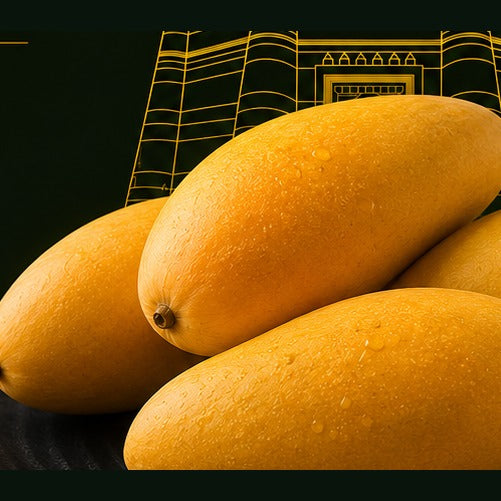
Sindhri Mango — Complete Guide to Pakistan's Early-Summer Queen
Sindhri (سندھڑی آم, also spelt Sindri / Sendhri) is Pakistan's earliest major mango variety — large oval golden fruit (300–500g), fiberless flesh, clean vibrant sweetness with citrusy notes. Originally from the Mirpurkhas region of Sindh province (hence the name). Peak season early June through mid-July. Often called 'the queen of mangoes' in Pakistan for size and early arrival. Multan also produces excellent Sindhri now — the Multani Sindhri sub-cultivar is slightly more concentrated in flavor than the Sindh-grown original.
Why Sindhri starts the Pakistani mango season
Sindhri's earliness is its defining commercial trait. While other Pakistani varieties wait for July or August, Sindhri trees flower in late January and produce ripe fruit by mid-June. For Pakistani households, the arrival of fresh Sindhri at the fruit shop is the signal that summer has truly begun.
This earliness has commercial implications: Sindhri commands premium pricing in early June (scarcity) and falls as Chaunsa enters the market in mid-July. Smart Pakistani buyers stock up on Sindhri in late June through early July when prices are still strong but supply is abundant.
Origin — Mirpurkhas, Sindh province
Sindhri originated in the Mirpurkhas district of Sindh province in southern Pakistan. The name literally means "of Sindh." Local cultivation dates to at least the early 20th century, possibly earlier — some accounts trace the variety to mid-1800s.
The Mirpurkhas region's combination of:
- Hot dry summers (45°C+)
- Alluvial soil from the Indus river system
- Moderate-to-low humidity
- Sufficient groundwater for irrigation
...produced the distinctive Sindhri character. Today Sindhri is grown in both Sindh (the original) and southern Punjab (the expansion).
Sindh-grown vs Multan-grown Sindhri
| Factor | Sindh-grown Sindhri | Multan-grown Sindhri |
|---|---|---|
| Origin region | Mirpurkhas, Tando Allahyar, Sindh | Multan, Bahawalpur, southern Punjab |
| Size | Larger (often 400–500g) | Slightly smaller (300–400g) |
| Sweetness | 17–19° Brix | 18–20° Brix (marginally higher) |
| Aromatic complexity | Mild | Slightly more pronounced (Punjab climate) |
| Shipping tolerance | Excellent | Excellent |
| Peak season | Mid-June through mid-July | Same |
| Best for | Daily eating, kids, low-key serving | Same plus mango lassi, kheer |
Our Multani Sindhri box uses Multan-grown fruit. We've grown Sindhri in our family orchards since our father, Malik Altaf, added the trees in the 1970s.
Cultivation specifics
| Factor | Detail |
|---|---|
| Tree age to full production | 4–6 years (faster than Chaunsa) |
| Annual yield per mature tree | 100–200 kg (highest of Pakistani premium varieties) |
| Flowering period | Late January – early February |
| Harvest window | Mid-June through mid-July (Punjab) / June through July (Sindh) |
| Peak quality window | Last week of June through first week of July |
| Average fruit weight | 300–500 grams |
| Sugar content (Brix) | 17–20° at peak |
| Skin character | Smooth, golden yellow uniform when ripe, thicker than Chaunsa |
| Flesh character | Pale yellow to deep yellow, fiberless, very juicy |
| Seed character | Medium-large flat seed |
Sindhri's flavor profile
Aroma
Mild. Sindhri has a clean, sweet, slightly citrusy aroma when ripe — not the intense floral perfume of Chaunsa. The smell is unmistakably mango but understated. Some find this an advantage (less "perfumed" character, easier to combine with other flavors); others miss the aromatic complexity of Chaunsa.
Taste
- Front of palate: Bright, vibrant sweetness with a citrus brightness
- Mid-palate: Juicy, fiberless flesh; sustained sweetness
- Finish: Clean, refreshing exit; no lingering aromatic complexity
If Chaunsa is the "dessert mango," Sindhri is the "thirst mango" — refreshing, hydrating, the kind you can eat one of without feeling overwhelmed.
Pros and cons of Sindhri
| Pros | Cons |
|---|---|
| Earliest major Pakistani variety (June) | Less aromatic than Chaunsa |
| Largest Pakistani commercial mango | Larger fruit can be hard to manage |
| Fiberless, very juicy | Shorter peak window (~3 weeks) |
| Excellent travel tolerance (thicker skin) | Lower Brix than Chaunsa or Anwar Ratol |
| Kid-friendly (easy to slice) | Less prestige than Chaunsa for formal gifting |
| Lower price than Chaunsa | — |
FAQs about Sindhri
What does "Sindhri" mean?
It literally means "of Sindh" — named after Sindh province where the variety originated.
Where is Sindhri grown in Pakistan?
Originally Sindh (Mirpurkhas, Tando Allahyar). Now also extensively in southern Punjab (Multan, Bahawalpur).
Why is Sindhri so large?
Genetic trait of the variety combined with the warm Sindhi/Punjab climate. Trees reliably produce 300–500g fruit, with some reaching 600g+.
When is Sindhri season in Pakistan?
Mid-June through mid-July. Our Multani Sindhri box dispatches from 15 June 2026.
Sindhri vs Chaunsa — which is better?
Different mangoes for different purposes. Sindhri is the daily-eating, breakfast, kid-friendly mango. Chaunsa is the dessert, aromatic, gifting mango. See our full comparison.
Order Pakistan's premium mangoes
Browse our 2026 harvest — hand-picked, naturally ripened, cold-chain shipped Pakistan-wide.
— The Malik family
1636/13-A, Pir Khursheed Colony, Multan, 66000, Pakistan