
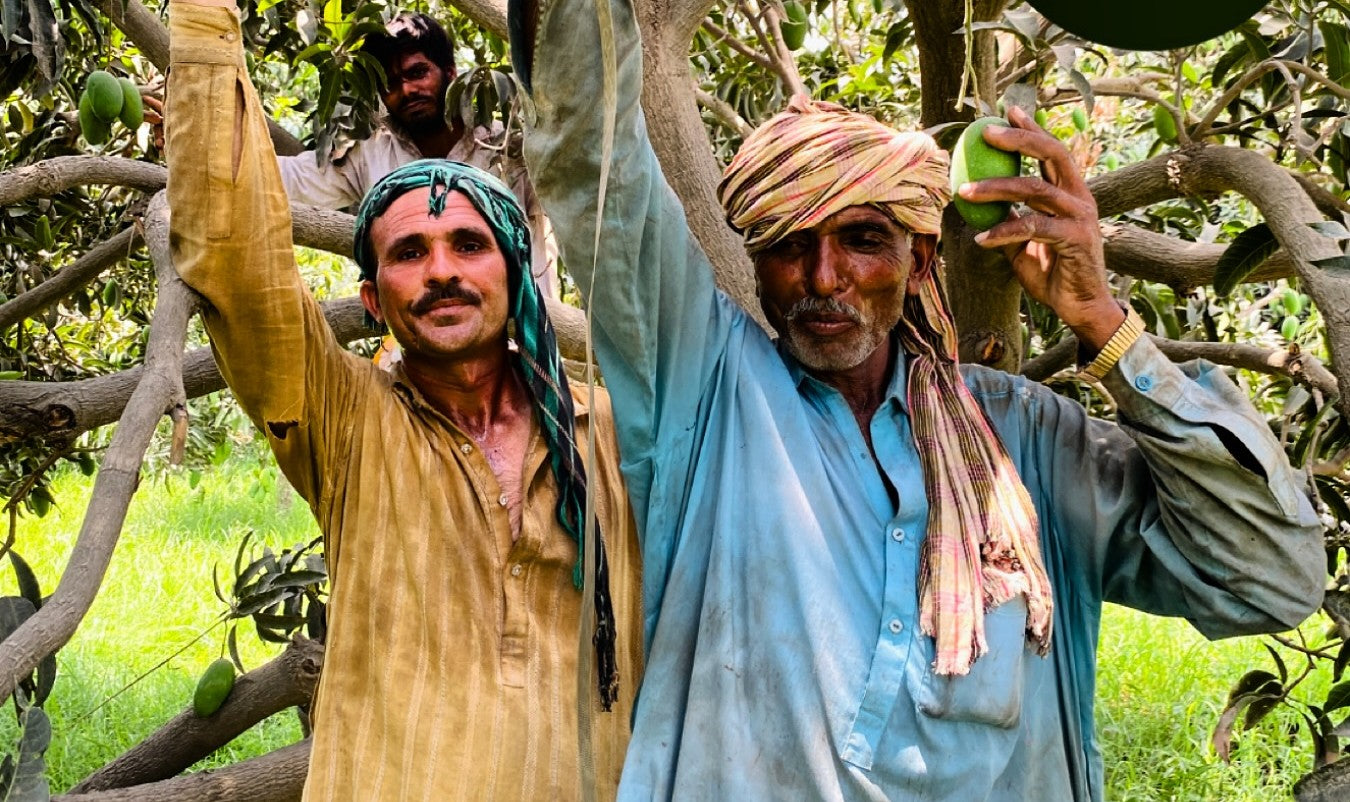
Inside a Multan Mango Farm: How MMangoes Grows Our Crop
An inside look at the Malik family mango farm in Pir Khursheed Colony, Multan — three generations of orchard work, what a typical harvest day looks like, and how a mango actually gets from a tree to your kitchen.
Most people who buy mangoes online have no idea what a mango farm looks like. The fruit shows up in a box, the box is opened, the mangoes get eaten, and the rest of the story is invisible. We thought it was worth writing down the rest of the story — both because we're proud of the work, and because we think people who eat our fruit have a right to know how it's actually grown.
Where we are
The Malik family orchards sit in Pir Khursheed Colony, a rural pocket south of Multan city. Multan is in southern Punjab, Pakistan, and it has been Pakistan's mango heartland for centuries — the soil, the heat, the river-fed water table, and the long sunny season conspire to produce mangoes that grow nowhere else quite the same. We are part of the wider Multan growing region that supplies the country and (in good years) the world with Chaunsa, Sindhri, Langra, Dussehri, and Anwar Ratol.
Our trees are not in some glossy commercial industrial farm. They're working trees in working orchards — some of them old enough to have been planted by our grandfather, Late Haji Laal Muhammad, in the 1960s and 70s. A few of the original Chaunsa trees are still producing. Those particular trees give us roughly 80–120 fruit per year each, which is a fraction of the yield of a modern grafted cultivar — but the fruit they produce is incomparable.
Three generations
Generation 1: Late Haji Laal Muhammad
Our grandfather started the orchards in an era when farming was the entire family business — there was no "mango export industry", there were no premium fruit boxes, and what you grew, you sold at the local mandi or you ate yourself. Hard work and patience built the orchards from scratch, tree by tree. The Nawabpuri White Chaunsa trees he planted are still producing today, more than half a century later. He is no longer with us, but his hands shaped what we still do every day.
Generation 2: Malik Altaf
Our father took over and expanded the orchards. He added Sindhri, Langra, and the Anwar Ratol cultivars. He insisted on natural ripening when commission agents started pushing calcium carbide in the 1990s — a stand that cost us short-term yield and gained us long-term reputation. He also made the call to keep the orchards in the family rather than sell to one of the big commercial mango exporters. We're glad he did.
Generation 3: today
The third generation runs the operation now. Same trees, same standards, modernized only in the parts that didn't compromise the fruit — cold-chain transport, online ordering, photographed and traceable batch packing. Our orchards are not certified organic on paper (Pakistani organic certification is expensive and frequently meaningless), but we manage them with minimal-input practices: balanced pruning, integrated pest management, and natural ripening only.
A year on the farm
Most people imagine "mango farming" as a summer activity. In reality, the work is year-round.
October–December: Post-harvest reset
Once the previous season's mangoes are gone, we go through every tree in the orchards. Pruning. Removing diseased wood. Treating trunks with lime wash to prevent borer infestations. Adding organic matter to the soil around the root zones. This is the quiet, unglamorous work that makes the next year's crop possible.
January–February: Flowering
This is the make-or-break window. Mango trees flower in January–February, and a late cold snap, an early heat wave, or a hailstorm at the wrong moment can destroy 50% of the season's potential crop in 48 hours. We've had years where we lost half the flowers to weather. There's nothing you can do — except plan for the variance and not put everything into one variety.
March–April: Fruit set
Pollinated flowers become tiny green fruit. Most of these will fall (the tree self-prunes — it knows it can only ripen so many fruit per branch). The ones that hold start to grow. We monitor for fruit fly damage (the major mango pest in Pakistan), which means strategic pheromone traps placed throughout the orchards. No broad-spectrum insecticide application during fruit development — the fruit is what people eat, and we don't sell what we wouldn't eat ourselves.
May–June: Maturation
Fruit reaches its full size but isn't yet ripe. The first Sindhri come ready in early June — the earliest variety. Watering is critical now; mango trees pull deep water, and the right water schedule sets the sugar content of the eventual fruit.
July–August: Harvest
The big six weeks. We pick by hand, every morning, walking the orchards row by row with bamboo poles fitted with cutting blades and small catch baskets. Each variety has its window — Sindhri winding down as Langra and Chaunsa come on, with Anwar Ratol bringing up the rear.
September: Tail end
Late-season Honey Chaunsa from the higher branches. We stop selling once quality drops — there's always some grower happy to push end-of-season fruit at a discount, but we'd rather close the season strong than dilute our name with mediocre boxes.
A typical harvest day
5:30 AM. Pre-dawn. The harvest team — about a dozen people, including family — gathers at the equipment shed. Light breakfast (parathas, chai, sometimes mango if the previous day's count had some that ripened in the cool-room overnight).
6:00 AM. First light. We move out to the section of orchard being harvested today. The team leader points out which trees and which branches are ready — this is judged by eye, by feel, and by the slight downward angle the fruit takes when it's mature. Mangoes are not all ready at once on the same tree; we'll come back to this tree in 3 or 4 days for the next round.
6:00 AM – 10:30 AM. Picking. Each fruit is cut with a small section of stem still attached (this prevents sap from leaking onto the skin, which causes black stem-rot during storage). The fruit goes into a soft catch basket, then transferred to padded crates. We don't pile fruit deep — bruising during picking is one of the biggest causes of bad mangoes downstream, and it's entirely preventable.
10:30 AM – 12:00 PM. Field sorting. Crates come to the packing shed. We sort by size (S, M, L), by variety, and by ripeness stage (most fruit is at "mature green" — 0–2 days from ripening). Anything with bruise, sunburn, or pest damage gets removed (and either eaten by the team or composted on-farm). Anything that's already ripe goes to the local market or to family — it can't survive shipping.
12:00 PM – 1:30 PM. Lunch break. Multani summer heat is no joke; afternoon work is for indoor packing.
1:30 PM – 5:00 PM. Cool-room rest. Sorted fruit goes into the controlled-temperature ripening room (16–18°C). We monitor each batch daily. Fruit stays here for 24 to 72 hours depending on variety and stage at harvest.
5:00 PM – 7:00 PM. Packing of the previous batch (fruit that was harvested 1–3 days ago and is now at the right ripeness stage for shipment). Each mango is wrapped in food-grade paper. Boxes are packed by variety and size grade, labeled with harvest date and dispatch date.
Next morning, dispatch. The boxes ship in cold-chain (refrigerated transit) via vetted couriers. By the time you, sitting in Karachi or Lahore or Islamabad, take delivery 2 to 5 working days later, the fruit is in the final stage of natural ripening — ready for 1–3 days of counter-ripening at your end before peak eating.
What we're proud of
- Zero carbide. Not since the orchards were planted. Period.
- Single-source traceability. Every box ships from our packing facility. Not a single mango passes through a commission agent or wholesale market on the way to you.
- Three independent verifications. Google Business Profile, Meta Business, Shopify Payments — all confirm our physical address and identity.
- Customer-first damage policy. Less than 2% damage rate in 2025; the boxes that did arrive damaged were replaced or refunded without question.
- Family name on every box. We don't hide behind a generic brand. The Malik family runs this; if you have a problem, you message us directly.
What we're not
- We are not an export company. We focus on Pakistani households.
- We are not a marketplace or reseller. We grow and ship our own fruit only.
- We are not the cheapest mango option in Pakistan. We are the right one for people who care about taste.
- We are not a year-round mango business. The season runs roughly May through September. The rest of the year we're tending the orchards for next season.
Come visit
If you're ever in or near Multan during mango season, you're welcome to visit the farm by appointment. WhatsApp us at +92 300 9555810 a few days ahead — we'll show you around, pick a fruit straight off a tree, and let you taste what a real Chaunsa is like the moment it's harvested. It's the kind of thing you don't forget.
Frequently asked questions
How big is your farm?
We don't publish exact acreage — but we run multiple connected orchards in the Pir Khursheed Colony area of Multan. The scale is "family farm" rather than "industrial plantation" — small enough that we know every tree, large enough to ship boxes Pakistan-wide.
Do you ever sell to wholesalers?
Rarely, and only at season's end with overflow fruit. Our entire premium harvest goes through our own boxes. If you see a mango labeled "Multan farm" at a fruit shop or supermarket, it's not from us — we don't supply resale.
Are your mangoes organic?
We don't carry organic certification (it's a paperwork process that, in Pakistan, often means little), but we use integrated pest management, no broad-spectrum insecticide during fruiting, and no calcium carbide for ripening. In practice this is closer to truly organic than most labeled-organic produce in Pakistan.
Do you offer corporate bulk orders?
Yes — for offices, weddings, Eid gifting, and similar. Email us with your quantity (e.g., "30 medium Chaunsa boxes to deliver to a Karachi office") and we'll send a quote. We've done multi-box dispatches to Islamabad ministries, Karachi banks, and Lahore corporate offices.
Can I order a sample box first?
Our 5kg box (approximately 12–16 fruit depending on variety) starts at Rs 2,550 for Langra and goes up to Rs 3,150 for Anwar Ratol 12 Number. That's the easiest entry point — small enough to try the variety without committing to a 10kg box. If you like it, you can re-order any time.
Try a box from this season's harvest
Our 2026 mango season is on. Browse our premium mango boxes — Nawabpuri White Chaunsa, Mosami White Chaunsa, Multani Sindhri, Multani Langra, Multani Anwar Ratol. Hand-picked, naturally ripened, cold-chain shipped Pakistan-wide. Free delivery on every order. Cash on Delivery on every order.
— The Malik family
1636/13-A, Pir Khursheed Colony, Multan, 66000, Pakistan
Hand-picked from our 3-generation Multan family farm, cold-chain delivered nationwide, Cash on Delivery on every order.
Shop the Nawabpuri White Chaunsa Premium Box → Shop the Mosami White Chaunsa Box