
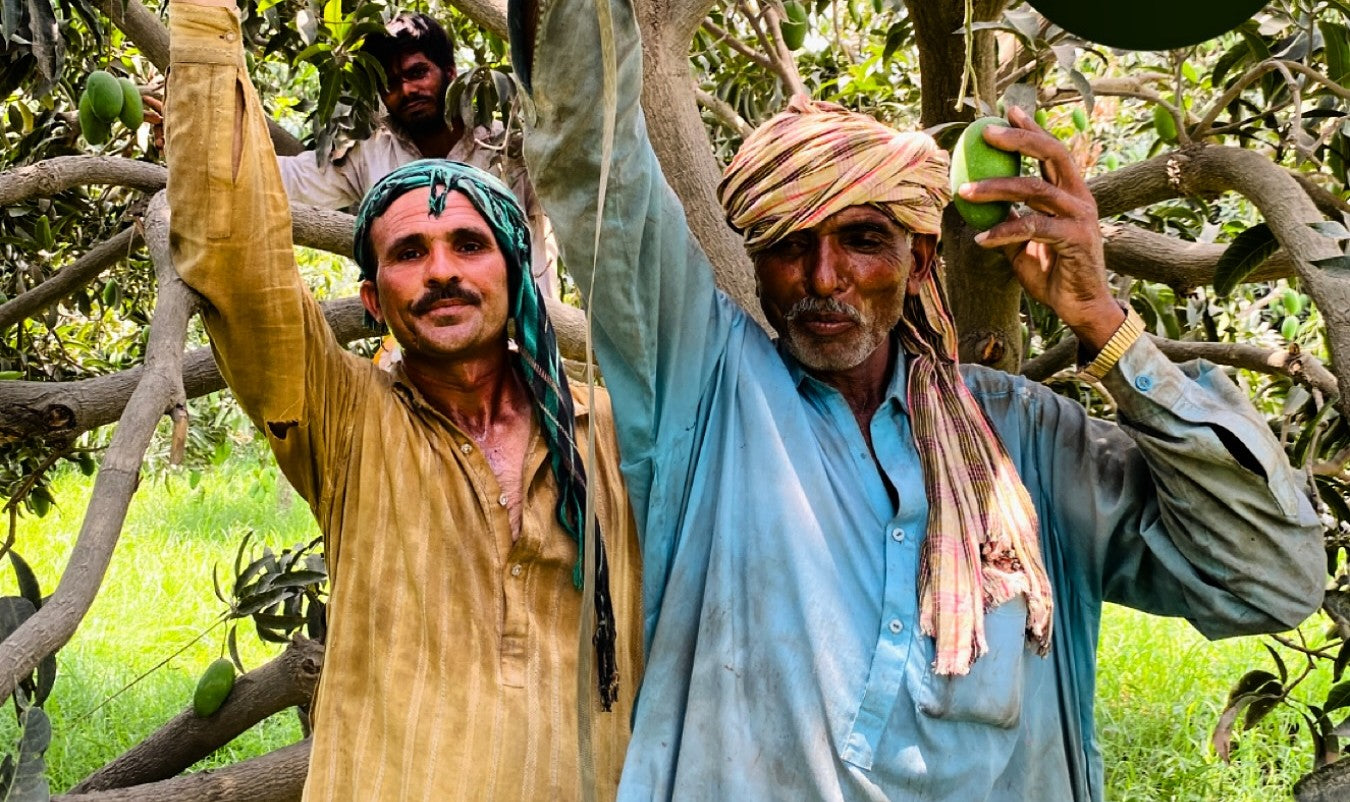
Carbide-Free Mangoes: Why Naturally Ripened Mangoes Taste Better (and Are Safer)
A grower's explainer on artificial vs natural mango ripening — what calcium carbide is, why it's banned in most countries, and how to tell the difference at the kitchen counter.
If you've ever bought a mango from a street vendor or supermarket in Pakistan, eaten one slice, and thought "this doesn't taste right" — there's a strong chance the fruit was ripened with calcium carbide. It's an open secret in the Pakistani fruit trade, and it ruins more boxes of premium mango than any other single factor. This is what's going on, why it matters, and how to avoid it.
What is calcium carbide?
Calcium carbide (CaC₂) is a grey, rock-like industrial chemical compound. Its primary legitimate use is in steel manufacturing and acetylene gas production — i.e., welding torches. When calcium carbide reacts with moisture in the air (or with the surface of fruit), it releases acetylene gas. Acetylene is structurally similar to ethylene — the natural plant hormone that triggers ripening — so it can artificially induce a fruit to turn yellow, soften, and look "ripe" within 24–48 hours.
The problem: acetylene is not the same as ethylene. It changes the appearance of the fruit without producing the underlying biochemical changes (starch-to-sugar conversion, flavor development, aroma compounds) that natural ripening achieves. The result is a mango that looks beautiful on the outside but is starchy, sour, and lifeless inside.
It's also dangerous. Industrial-grade calcium carbide contains trace amounts of arsenic and phosphorus hydride — the impurities that the chemical industry hasn't bothered to remove because, for welding, they don't matter. When used on fruit, those impurities transfer to the skin and (over time, through repeated exposure) into the flesh.
Where carbide-ripened mangoes are illegal
Most developed countries have banned the use of calcium carbide as a ripening agent. A few examples:
- European Union: Banned under Regulation (EC) No 1107/2009.
- United Kingdom: Banned under Food Safety Act 1990 + retained EU regulations.
- United States: Not approved under FDA food additives — effectively banned.
- Canada: Not approved for fruit ripening under Health Canada regulations.
- UAE: Banned by the Emirates Authority for Standardization & Metrology (ESMA).
- Saudi Arabia: Banned by the Saudi Food and Drug Authority (SFDA).
- India: Banned under the Prevention of Food Adulteration Act, 1954 (Rule 44AA) — though enforcement is patchy.
- Pakistan: Technically prohibited under the Pakistan Pure Food Ordinance, 1960 — but enforcement is essentially nonexistent in retail and the practice remains widespread.
If you eat a mango in Dubai, London, or Toronto, it has almost certainly been naturally ripened. If you buy one off the street in Lahore or Karachi without asking, the odds are uncomfortably high that it has been chemically ripened.
How natural ripening actually works
A mango is a living thing. When it's harvested at the right stage of maturity — what growers call "physiological maturity," where the fruit has developed all the precursors of flavor but hasn't yet softened — it ripens on its own through a precisely orchestrated sequence of biochemical events.
The fruit produces its own ethylene gas. Ethylene activates enzymes that break down starches into sugars (sucrose, fructose, glucose) — this is what produces sweetness. Other enzymes break down pectin in the cell walls — this is what produces softness. Volatile flavor compounds (esters, terpenes, lactones) are synthesized — this is what produces aroma. Beta-carotene develops — this is what produces the yellow-orange flesh color. None of these processes happen instantly; they need days at controlled temperature to play out fully.
This is why traditional Pakistani mango growers store harvested fruit in cool, dry rooms for 3–7 days before it ships — to give the fruit time to ripen on its own terms. Done correctly, the result is a mango with full sweetness, intense aroma, and the buttery-soft texture you remember from the best mango you ever ate.
How to tell a naturally-ripened mango from a carbide-ripened one
Six signs to check before you buy — or before you eat the one that just arrived.
1. The smell
This is the single most reliable test. A naturally-ripened mango smells strongly through the skin — honey, jasmine, citrus, sometimes a hint of resin. A carbide-ripened mango smells almost nothing, or worse, smells faintly chemical (a slight garlic-like odor is the giveaway).
2. Skin color
Natural ripening produces uneven coloring — typically yellow with some green patches near the stem, small natural sugar spots (also called "honey spots" or "lenticels"), and slight variation between fruit. Carbide ripening produces eerily uniform yellow over the entire fruit, often with no spots at all. Too perfect is suspicious.
3. Skin texture
Natural-ripened skin has a slightly waxy or lightly textured surface. Carbide-ripened skin can appear unusually shiny or have a faint dusty deposit (residual carbide powder).
4. Flesh color and texture
Cut the mango. Natural-ripened flesh is uniformly orange-yellow, with a buttery soft texture all the way through. Carbide-ripened flesh is often pale near the stone, with a chalky or starchy mouthfeel, and may have unripe greenish patches that the chemical "ripening" never penetrated.
5. Taste
Natural-ripened mango tastes sweet through and through, with complex aromatic notes that develop on the back of the palate after swallowing. Carbide-ripened mango tastes flat — sweet enough at the front, but with no lingering aroma and often a starchy or sour aftertaste.
6. The "rice water" test (for the truly suspicious)
Drop the mango into a bowl of water. A naturally-ripened mango sinks (its density is consistent because the ripening is complete throughout). A carbide-ripened mango sometimes floats because pockets of unripe starch are less dense. This isn't 100% reliable but it's a fun party trick.
The "ethylene chamber" middle ground
To be fair to the trade: not all artificial ripening is bad. The accepted modern method, used in countries with proper regulation, is the ethylene chamber — a controlled-atmosphere room where harvested fruit is exposed to a precise concentration of food-grade ethylene gas (50–150 ppm) at controlled temperature (18–22°C) and humidity (90–95%) for 24–72 hours. Done correctly, ethylene chamber ripening produces fruit that is indistinguishable from naturally ripened — because it is natural; it just speeds up the same process the fruit would do on its own.
The catch: ethylene chamber ripening requires capital investment, training, and ongoing maintenance. Most Pakistani small farmers and commission agents can't afford it, so they reach for the cheap shortcut: carbide. In the rare cases where you see "ethylene-chamber ripened" properly labeled on a Pakistani mango box, it's a good sign.
Why our family farm doesn't use carbide
The Malik family has been growing mangoes in Multan since the time of our grandfather, Late Haji Laal Muhammad. We've never used calcium carbide on a single mango — not because it's illegal (though it is), but because we'd never eat one of our own mangoes if we did.
Our process, from tree to your kitchen:
- Field maturity check. Each tree is checked daily as the season approaches. We harvest only when the fruit has reached physiological maturity — typically determined by skin color shift, the angle of fruit hanging on the stem, and (yes) experienced thumb-pressure on a sample.
- Hand-pick at dawn. Pre-dawn picking keeps fruit cool. Each mango is harvested with the stem intact (no stem-stem rot during storage).
- Field-grade sorting. Mangoes are sorted on the farm by size, ripeness stage, and visual quality. Anything with bruise, sunburn, or pest damage is removed (and either eaten by us or composted).
- Cool-room ripening, 24–72 hours. Harvested fruit goes to a controlled-temperature ripening room — no chemicals, just controlled atmosphere. We monitor each batch daily.
- Pack the morning of shipment. Boxes are packed individually with paper cushioning to prevent in-transit bruising. Each box is sealed and labeled with the variety, harvest date, and ripeness stage.
- Cold-chain dispatch. Boxes ship in refrigerated transit (typically 8–12°C) via vetted courier partners to all major Pakistani cities. Transit time: 2–5 working days.
The end-to-end process from tree to your door is between 4 and 10 days — and every day of it is monitored. Nothing in that chain involves a chemical that can't ripen its own fruit.
Frequently asked questions
Is calcium carbide ripening really that common in Pakistan?
Yes. Multiple studies by Pakistani food safety bodies have found 50–80% of retail mangoes in major city wholesale markets test positive for residual carbide or acetylene exposure. The exact number varies by year and region, but it's the default in the unregulated retail trade.
Will eating a carbide-ripened mango make me sick immediately?
One mango, occasionally — almost certainly no acute reaction. Long-term, chronic, repeated exposure to the arsenic and phosphorus impurities in industrial carbide is the genuine concern — particularly for children. The other concern is simpler: you paid for a premium fruit and got a chemically-treated one that doesn't taste like anything.
How do I make sure my online mango order is naturally ripened?
Buy directly from a farm. Look for a verified physical address, photos of the orchard, named varieties (not just "Pakistani mango"), and explicit mention of natural ripening with cold-chain transit. Avoid resellers and "best-quality" mango shops that can't trace their fruit back to a specific farm.
Does washing the mango remove carbide?
Surface residue, somewhat. The underlying issue — that the fruit was chemically forced to turn yellow without developing its actual flavor — washing cannot fix. The fruit will taste flat no matter how clean it is.
If I buy a Chaunsa box from MMangoes, can I be sure it's not carbide-ripened?
Yes. Every mango we sell is grown on our family farm in 1636/13-A, Pir Khursheed Colony, Multan, hand-picked at maturity, naturally ripened in our own cool-room, and cold-chain shipped. We have no commission agents in the chain — the fruit goes from our tree to your door, full stop. Our business is verified on Google Business Profile, Meta Business, and Shopify Payments. If a customer ever sends us a fruit they think is off, we replace the entire box and refund. We've been doing this for three generations and we're not about to start cheating on our own family name.
Order naturally-ripened mangoes this season
Our 2026 premium boxes are in stock — Nawabpuri White Chaunsa, Mosami White Chaunsa, Multani Sindhri, Multani Langra, and Multani Anwar Ratol (12 Number). All hand-picked, naturally ripened, cold-chain shipped Pakistan-wide. Free delivery on every order. Cash on Delivery on every order.
— The Malik family
Multan, Pakistan
Order Fresh from Our Multan Orchard
Hand-picked from our 3-generation Multan family farm, cold-chain delivered nationwide, Cash on Delivery on every order.
Shop the Nawabpuri White Chaunsa Premium Box → Shop the Mosami White Chaunsa Box