
Mango Mousse Cake Recipe (No-Bake & Eggless)
This mango mousse cake recipe delivers everything a no-bake dessert should: a buttery biscuit base, an impossibly light and creamy mango mousse, and a glossy mango jelly crown — all without turning on the oven. The secret? You need mangoes that are already perfumed, fibre-free, and bursting with natural sweetness. Pakistani Sindhri and White Chaunsa are the two varieties we reach for at the farm in Multan, and both transform an ordinary cream-and-gelatin mousse into something that genuinely tastes of sunshine. If you have been searching for a no bake mango mousse cake or a completely eggless mango mousse you can trust for a celebration, you have found the right recipe.
We have tested this recipe over several summers, adjusting the gelatin ratio, the cream-to-pulp balance, and the base thickness until every slice set perfectly and cut clean. The result is a mango cake recipe that works as a birthday centrepiece, an Eid dessert, or simply a way to honour the short, precious weeks when Sindhri or Chaunsa is at peak ripeness. Below you will find everything — ingredients with substitutions, step-by-step method, tips from our kitchen, flavour variations, storage guidance, and a thorough FAQ.
Ripe mangoes are non-negotiable here. Overripe or carbide-ripened fruit produces a flat, slightly fermented note that no amount of cream can mask. Our mangoes are picked by hand at full orchard ripeness and cold-chain handled right to your door, which means the pulp you scoop out is dense, deeply fragrant, and naturally sweet enough to reduce the added sugar. Shop our premium Pakistani mango gift boxes to have farm-direct Sindhri or Chaunsa delivered nationwide — with Cash on Delivery and free delivery across Pakistan.
Why Pakistani Mangoes Make the Best Mango Mousse Cake
Mousse is mostly air, cream, and fruit. That means the fruit flavour has nowhere to hide — and nowhere to amplify itself except through its own natural complexity. Pakistani mangoes are among the most aromatic in the world, and two varieties stand out for desserts:
- Sindhri (peaks in June): golden, honeyed, completely fibre-free. The pulp yields easily from the skin, is thick and custard-like, and carries a floral sweetness that perfumes an entire room. Ideal for mousse because it needs almost no added sugar and blends into a silky emulsion.
- Nawabpuri White Chaunsa / Mosami White Chaunsa (August): buttery, rich, slightly tangy at the skin edge. The flesh is paler gold and denser. It produces a mousse with more body and a longer finish on the palate. Our White Chaunsa premium box arrives at the same hand-picked, carbide-free standard as every box we pack.
- Langra (July): aromatic, tangy-sweet, green-skinned. Excellent in a mousse layered with Sindhri for a two-tone effect (see Variations section).
| Variety | Season | Flavour Profile | Best Use in This Cake |
|---|---|---|---|
| Sindhri | June | Honeyed, floral, fibre-free | Main mousse layer — silkiest result |
| Langra | July | Aromatic, tangy-sweet | Second mousse layer for two-tone cakes |
| Anwar Ratol / 12 Number | July | Intensely sweet, paper-thin seed | Jelly topping — concentrated glaze |
| Nawabpuri White Chaunsa | August | Buttery, rich, pale gold | Dense mousse with longer palate finish |
| Mosami White Chaunsa | August | Creamy, mild sweetness | Blended with Sindhri for a balanced mousse |
Ingredients for Mango Mousse Cake (Serves 10–12)
For the Biscuit Base
- 200 g digestive biscuits (or Marie biscuits, or Graham crackers)
- 80 g unsalted butter, melted
- 1 tablespoon caster sugar (optional — omit if biscuits are already sweet)
- Pinch of fine salt
For the Mango Mousse Layer
- 500 g fresh ripe mango pulp (about 3 large Sindhri or 4 medium Chaunsa mangoes, blended smooth)
- 400 ml fresh whipping cream (35% fat), well chilled
- 200 g cream cheese or thick labneh, at room temperature
- 60–80 g icing (powdered) sugar, adjusted to mango sweetness
- 2½ teaspoons (8 g) unflavoured gelatin powder
- 3 tablespoons cold water (for blooming gelatin)
- 1 teaspoon pure vanilla extract
- Juice of half a lime (brightens the mango flavour)
For the Mango Jelly Topping
- 200 g fresh mango pulp
- 150 ml water or mango juice
- 1½ teaspoons (5 g) unflavoured gelatin powder
- 2 tablespoons water (for blooming)
- 2 tablespoons caster sugar (optional)
To Decorate (Optional)
- Thin mango slices, fanned across the jelly
- Fresh mint leaves
- Edible flowers
- Toasted coconut flakes
Equipment: 9-inch (23 cm) springform tin, electric hand mixer or stand mixer, blender, small saucepan, cling film or acetate collar.
Step-by-Step Instructions
Step 1 — Make the Biscuit Base
- Crush the biscuits to fine crumbs in a food processor, or seal them in a zip-lock bag and bash with a rolling pin.
- Combine crumbs with melted butter, sugar, and salt. The mixture should hold its shape when pressed between your fingers.
- Line the base of a 9-inch springform tin with baking paper. Press the crumb mixture firmly and evenly across the base using the flat bottom of a glass.
- Refrigerate for at least 30 minutes while you prepare the mousse. A firm base prevents it from crumbling when the mousse is poured over.
Step 2 — Prepare the Mango Pulp
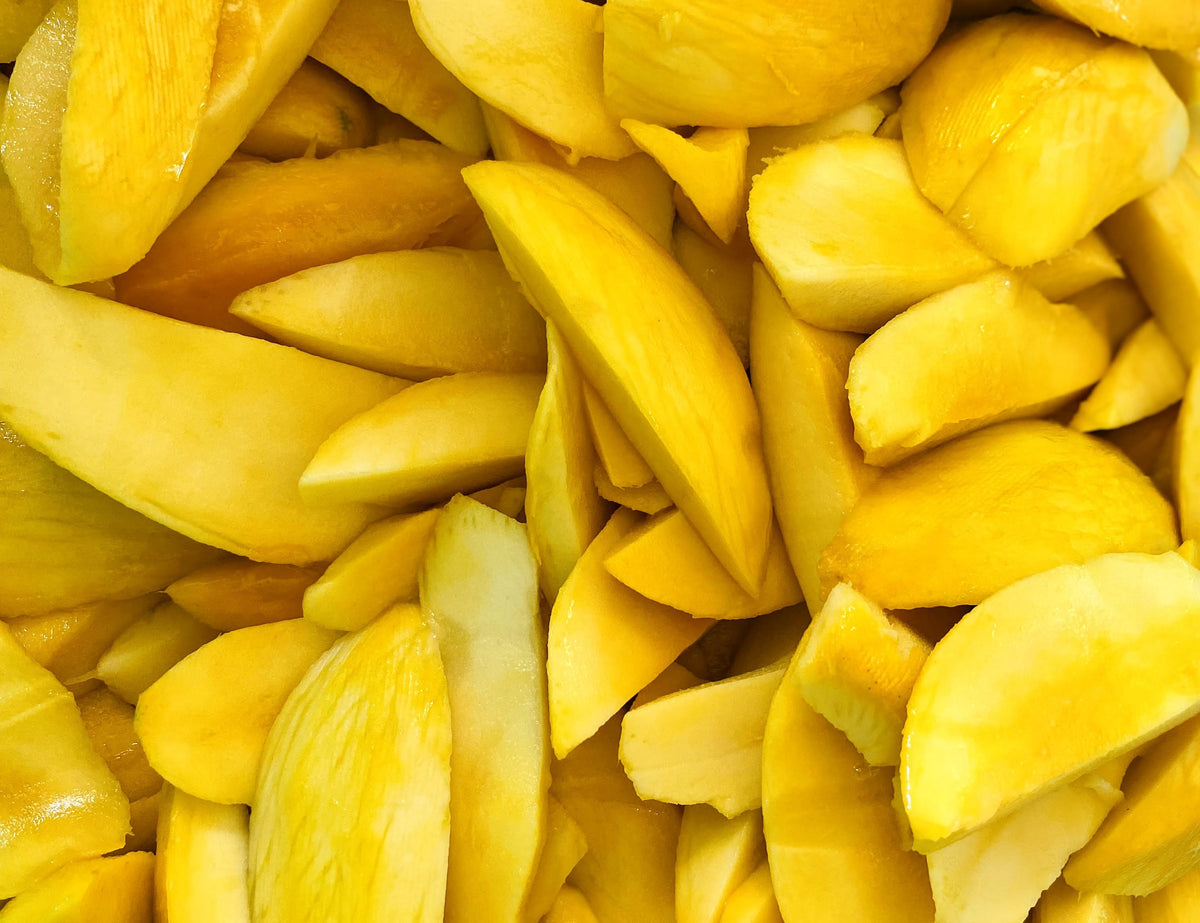
- Peel and cube your mangoes. Blend until completely smooth — no fibres, no lumps.
- Pass through a fine sieve if you want a perfectly silky result (usually unnecessary with Sindhri, which is naturally fibre-free).
- Stir in the lime juice. Taste: the pulp should be bright and intensely mango-forward. If it tastes flat, add another squeeze of lime rather than more sugar.
- Divide: set aside 500 g for the mousse and keep the remaining 200 g for the jelly topping.
Step 3 — Bloom and Dissolve the Gelatin
- Sprinkle 2½ teaspoons gelatin over 3 tablespoons cold water in a small heatproof bowl. Let it sit undisturbed for 5 minutes — it will absorb all the water and turn spongy.
- Set the bowl over a small pot of barely simmering water (bain-marie) or microwave in 10-second bursts, stirring between each, until the gelatin is completely clear and liquid. Do not boil.
- Let it cool to just above body temperature (about 35–40 °C). If it cools completely it will set before you incorporate it; if it is too hot it will deflate the cream.
Step 4 — Build the Mousse
- Beat the cream cheese with the icing sugar and vanilla in a large bowl until smooth and lump-free.
- Add the 500 g mango pulp to the cream cheese mixture and whisk until fully combined and uniform in colour. This is your mousse base.
- In a separate chilled bowl, whip the cream to medium-stiff peaks — it should hold its shape but still look glossy, not grainy.
- Stir the warm liquid gelatin briskly into the mango-cream cheese mixture (do this quickly and decisively so the gelatin disperses evenly before it starts to set).
- Working in three additions, fold the whipped cream into the mango mixture using a large spatula. Use a J-fold motion — cut down through the middle, sweep along the bottom, fold up over the top — to keep as much air as possible. The mousse should be pale gold and airy.
Step 5 — Assemble and Set
- Remove the chilled biscuit base from the refrigerator.
- Wrap the outside of the tin with cling film and run an acetate collar (or a strip of baking paper) around the inside edge of the tin to help the mousse release cleanly.
- Pour the mousse over the biscuit base in one confident pour, then tap the tin gently on the counter 3–4 times to release any large air pockets.
- Smooth the top with a palette knife or the back of a wet spoon.
- Refrigerate for a minimum of 4 hours, or ideally overnight. The mousse needs this time to firm through to the centre.
Step 6 — Make and Apply the Mango Jelly Topping
- Bloom 1½ teaspoons gelatin in 2 tablespoons cold water for 5 minutes. Dissolve as before.
- Warm the 200 g mango pulp with the water (or juice) and sugar in a small saucepan over low heat until just heated through — do not boil or the flavour dulls.
- Stir in the dissolved gelatin and mix well. Taste for sweetness. Remove from heat and let cool to room temperature (about 20–25 minutes). It must be cool but still pourable — if it starts to set at the edges, warm gently for a few seconds.
- Remove the mousse cake from the refrigerator. Pour the jelly gently over the set mousse, tilting the tin slowly to cover the surface evenly.
- Return to the refrigerator for at least 1 hour until the jelly is completely set.
Step 7 — Unmould and Decorate
- Run a thin palette knife or thin spatula around the edge of the tin, then release the springform clip slowly.
- Peel away the acetate collar. If the sides look uneven, run the palette knife lightly around to smooth.
- Arrange mango slices in a fan pattern over the jelly, add mint leaves, and serve within 30 minutes of slicing for the cleanest presentation.
Pro Tips for a Perfect No Bake Mango Mousse Cake
- Chill everything. A cold bowl and cold cream whip faster and to a more stable foam. Pop your mixing bowl and beaters in the freezer for 10 minutes before whipping.
- Gelatin temperature control is the single most important variable. Too hot and the gelatin kills the foam; too cold and it streaks. Aim for 35–40 °C when you stir it in — it should feel warm, not hot, on your wrist.
- Taste your mango first, sweeten last. A fully ripe Sindhri from our farm may need as little as 40 g icing sugar for the entire mousse. A less-sweet variety might need 80 g. Let the fruit guide you.
- Use full-fat cream. Reduced-fat whipping cream does not hold the same stable structure. The fat is what gives mousse its characteristic body. Minimum 35% fat content.
- Don't rush the set. Four hours is the minimum; overnight is better. If you cut the cake before the centre has firmed, the layers will slide and the biscuit base will fall apart.
- Serve cold, not frozen. Keep the cake in the refrigerator up until 10 minutes before serving. If it starts to warm up, the mousse softens quickly in Pakistani summer heat.
- Acetate collar trick. If you don't have an acetate collar, freeze the set cake for 20 minutes before unmoulding. The slight freeze firms the outer edge so the sides release cleanly.
Flavour Variations to Try
Two-Tone Sindhri and Langra Mousse
Divide the mousse recipe in half. Make one batch with Sindhri pulp, pour it over the base, and refrigerate for 2 hours until just set. Then make a second batch with Langra pulp (slightly tangier, greener in tone) and pour it on top. The two layers create a beautiful bicolour effect and a more complex flavour profile — golden underneath, pale chartreuse on top.
Coconut Mango Mousse Cake
Replace 100 ml of the whipping cream with chilled full-fat coconut cream. The coconut adds a subtle tropical depth that lifts the mango without competing with it. Works especially well with White Chaunsa, whose buttery character complements the coconut fat.
Mango and Cardamom
Add ½ teaspoon freshly ground green cardamom to the mousse base. Cardamom is one of the traditional spice companions to Pakistani mango desserts — it adds warmth and an almost floral spice note that pairs beautifully with Sindhri's honeyed sweetness.
Chocolate Base Variation
Substitute the digestive biscuits with chocolate digestives or Oreos (scrape out the cream filling). The bitter cocoa undertone of the base creates a contrast that makes the mango mousse feel even more vibrant and bright. This version photographs particularly well — dark base, golden mousse, glassy jelly.
Individual Mousse Cups (No Tin Needed)
If you don't own a springform tin, layer the crumb base, mousse, and jelly in individual serving glasses or ramekins. Set time is the same; serving is easier; and the layered look in a glass is impressive. Great for parties where individual portions matter.
Storage Instructions
The fully assembled and set mango mousse cake keeps well in the refrigerator for up to 3 days, covered with cling film or stored under a cake dome. After day 3 the mousse begins to weep slightly and the base softens. It does not freeze well once assembled — the gelatin-cream structure becomes grainy on thawing. However, you can freeze the biscuit base alone (wrapped tightly) for up to 2 weeks if you want to prep ahead.
If you are making this for a next-day event, the best approach is: bake the base on day one, pour the mousse and refrigerate overnight (day one evening), add the jelly topping in the morning, and serve that evening. This gives each layer the maximum set time and the freshest jelly topping.
Never leave this cake at room temperature for more than 30 minutes, especially in summer. The mousse will soften and the jelly surface will lose its gloss.
How to Make Mango Pulp from Fresh Mangoes
Many recipes call for canned mango pulp, and while that is a reasonable year-round option, nothing compares to fresh pulp from a ripe orchard-picked mango. Here is the fastest method:
- Squeeze method (for Sindhri and Chaunsa): Roll the mango firmly on a flat surface to loosen the pulp from the seed. Cut off the top, insert a spoon, and squeeze the pulp directly into a blender. No peeling needed. This is the traditional farm method — fast, minimal waste.
- Cube method (for any variety): Peel, slice off the two cheeks around the flat seed, score the flesh in a crosshatch, and invert each cheek to pop the cubes out. Scoop into a blender.
- Blend on high for 30–40 seconds until completely smooth. One large Sindhri (about 350–400 g unpeeled) yields roughly 180–200 g of pulp. You need about 3 mangoes for the full mousse recipe.
For the best flavour, use mangoes that are fragrant at the stem end, yield slightly to thumb pressure, and have no hard spots. Our farm packs every box at peak ripeness so the pulp is ready to use the day it arrives — no countertop ripening needed. Pair this recipe with our mango lassi recipe for a full mango dessert spread — the two recipes use pulp from the same mangoes and complement each other beautifully at a summer table.
Frequently Asked Questions
Can I use canned mango pulp instead of fresh mangoes?
Yes, Alphonso or Kesar canned pulp works technically — the gelatin and cream ratios stay the same. However, canned pulp is pasteurised and homogenised, which mutes the aromatic top notes that make this cake special. If you can access fresh Pakistani Sindhri or Chaunsa, the flavour difference is dramatic and worth the extra 10 minutes of prep. Fresh pulp from MMA Mangoes arrives carbide-free and at peak ripeness, so it blends into a mousse that smells and tastes like standing under the orchard canopy.
How do I make this recipe fully eggless?
This eggless mango mousse recipe contains no eggs at any stage. The mousse sets via gelatin and the structural fat of whipping cream, not via egg foam. The cream cheese adds body and tang without eggs. There is nothing to substitute — the recipe is already egg-free by design, making it suitable for vegetarians (note: gelatin is derived from animal collagen, so for a fully vegan version, substitute agar-agar powder at roughly the same quantity, though the set will be slightly firmer).
Why did my mousse not set properly?
The three most common reasons are: (1) the gelatin was not fully dissolved before being added — undissolved granules don't set evenly; (2) the gelatin was too hot when incorporated and partially broke down the cream foam; or (3) the cake was not refrigerated for long enough. If the centre is still wobbly after 4 hours, give it another 2 hours before cutting. Also check that your cream was whipped to stiff peaks, not just soft — under-whipped cream produces a mousse that never fully firms.
Can I make this mango mousse cake recipe without gelatin?
You can use agar-agar as a plant-based alternative. Use the same quantity by weight (8 g for the mousse, 5 g for the jelly). The key difference: agar must be boiled to activate, whereas gelatin only needs to be warmed. Boil the agar in the liquid, cool slightly, then incorporate. The resulting mousse will be slightly less creamy and more jelly-like in texture — it sets firmer and holds at slightly higher room temperatures, which is actually an advantage in Pakistani summers.
Which mango variety gives the most flavourful mousse?
Sindhri (June) is our first recommendation for mousse because of its fibre-free, custard-thick pulp and intensely honeyed aroma. The absence of fibres means it blends to a completely smooth, silky emulsion with no straining needed. White Chaunsa (August) produces a slightly denser, richer mousse with a longer finish — some testers prefer it for its buttery depth. Anwar Ratol / 12 Number Ratol, with its intensely concentrated sweetness, works best as a jelly glaze rather than the main mousse, as its higher sugar content can unbalance the cream ratio.
How far in advance can I prepare this cake?
The fully assembled cake (mousse set, jelly topping applied) keeps beautifully for up to 3 days covered in the refrigerator. For the best presentation, add any fresh mango slice decorations within an hour of serving — fresh mango on top of the jelly begins to oxidise slightly after a few hours in the fridge, losing its glossy golden colour. If you need to prepare further ahead, freeze the biscuit base separately (up to 2 weeks, well-wrapped), then assemble the mousse and jelly layers the day before serving.
Ready to make this recipe? The flavour starts with the mangoes. Our farm in Multan, Pakistan has been growing Sindhri, Chaunsa, Langra, and Anwar Ratol for three generations — hand-picked at full orchard ripeness, carbide-free, cold-chain packed, and delivered to your door across Pakistan with free delivery and Cash on Delivery. Order your premium Pakistani mango gift box today and have fresh orchard mangoes ready for this recipe within days. Questions? WhatsApp us on +92 300 9555810 — we'll help you pick the right variety for the cake you have in mind.